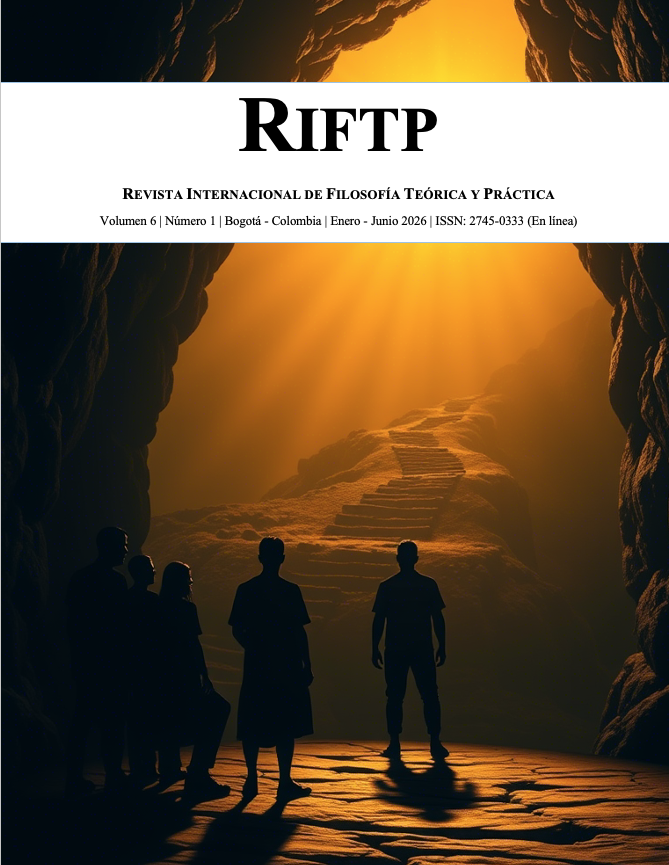
Plato's allegories: a pedagogical method for the pursuit of the good and critical thinking
DOI:
https://doi.org/10.51660/riftp61369Keywords:
Plato, platonic allegories, good, philosophical pedagogy, critical educationAbstract
This article analyzes Plato's main allegories — the Cave, the Sun, the Divided Line, and the Chariot — as pedagogical resources oriented toward critical formation and the pursuit of the Good. It begins with the Platonic conception of the Good as the supreme Idea and the foundation of truth and justice, showing how the allegories translate abstract concepts into comprehensible narratives that guide the soul from ignorance to the contemplation of what is true. The study draws on classical and contemporary sources that highlight the relevance of these images in current education, especially in the face of factors such as cultural alienation, social conformism, institutionalized ignorance, and technological dependence, which keep individuals at low levels of knowledge. It concludes that Plato's allegories constitute a coherent pedagogical system capable of renewing philosophical teaching and inspiring a critical and liberating educational practice, oriented toward justice and social transformation.
Downloads
References
Agustín de Hipona. (2003). De natura boni. Biblioteca de Autores Cristianos.
Aristóteles. (1998). Ética a Nicómaco. Gredos.
Borgmann, A. (1984). Technology and the character of contemporary life: A philosophical inquiry. University of Chicago Press.
Falvino, S. (2012). La escala, la línea y la imagen del sol: Los fundamentos protológicos de la idea de bien en Platón. Stylos, 21, 71–84.
Freire, P. (1970). Pedagogía del oprimido. Siglo XXI Editores.
Gallo González, M., Medina Peña, R., & Medina de la Rosa, R. (2019). Las alegorías platónicas y la enseñanza contemporánea: Metáfora en la era del conocimiento. Conrado, 15(67), 327–334.
García Casanova, M. G. (2010). El pensamiento pedagógico de Platón. Revista Española de Pedagogía, 68(247), 5–22.
Jaeggi, R. (2005). Alienation. Columbia University Press.
Kant, I. (2003). Fundamentación de la metafísica de las costumbres. Alianza.
Magnone, P. (2012). La alegoría del carro del alma en Platón y en la Katha Upaniṣad. Universidad Nacional de Mar del Plata.
Marcuse, H. (1964). One-dimensional man: Studies in the ideology of advanced industrial society. Beacon Press.
Morinigo, C. I. (2015). Platón y el mito de la caverna. Minerva Magazine of Science. DOI: https://doi.org/10.31070/RM2015CIM02
Nussbaum, M. (2006). Las fronteras de la justicia: Consideraciones sobre la exclusión. Paidós.
Platón. (2005). La República. Gredos.
Platón. (s. f.). Fedro (246a–254e).
Rorty, R. (1989). Contingencia, ironía y solidaridad. Paidós.
Tomás de Aquino. (2001). Suma teológica. Biblioteca de Autores Cristianos.
Varó Peral, Á. (s. f.). Platón: Teoría del conocimiento.
Vargas, H. (2021). Alegoría: Un proyecto pedagógico que va más allá de la creatividad. Revista Kaminu, 1(2), 45–52.
Downloads
Published
Issue
Section
License
Copyright (c) 2026 Revista Internacional de Filosofía Teórica y Práctica

This work is licensed under a Creative Commons Attribution-NonCommercial-ShareAlike 4.0 International License.
Articles are published under the terms of a licence that permits use, distribution and reproduction in any medium, provided that the original work is properly cited. Ed&TIC retains the proprietary rights to the published works and actively promotes the reuse of these works under the terms of the aforementioned licence, which encourages the dissemination of knowledge and collaboration in the academic community.